Instead of cutting VAT on petrol, the federal government should introduce a €9 ticket and expand public transport.
I cannot listen to this nonsense anymore. No matter how you turn the dog in the frying pan, public transport can absolutely NEVER replace private transport, only supplement it on certain heavily used standard routes.
Combinatorics
The problem with transport is combinatorics - the number of possible origins and destinations is already extremely large, and the number of possible combinations is almost endless. The road and path network solves this problem through extremely dense interconnection. In built-up areas, there are junctions every few dozen metres. This is not a problem: anyone who "does not need" a junction simply continues through it without interruption in their private vehicle. Roads do not have to wait for each other. If they are not heavily used, they do not cost much to maintain either. The expensive part of the road network is the one-off construction costs.
Public transport
With public transport of every kind, this is different. Regardless of actual usage, just providing it means that, beyond the capital cost of buying the vehicles, every single journey actively costs money for staff, energy, etc. Every node in the network makes it slower through stopping times for users who happen not to need that particular node - and each individual only needs a fraction of the nodes, but each one needs a different selection. Unlike simply turning off, changing services is annoying and causes waiting times.
Simply "expanding public transport", unlike expanding a road network, is therefore first of all tied to high daily recurring costs and additionally often makes the service worse even for existing users.
Two real-world examples
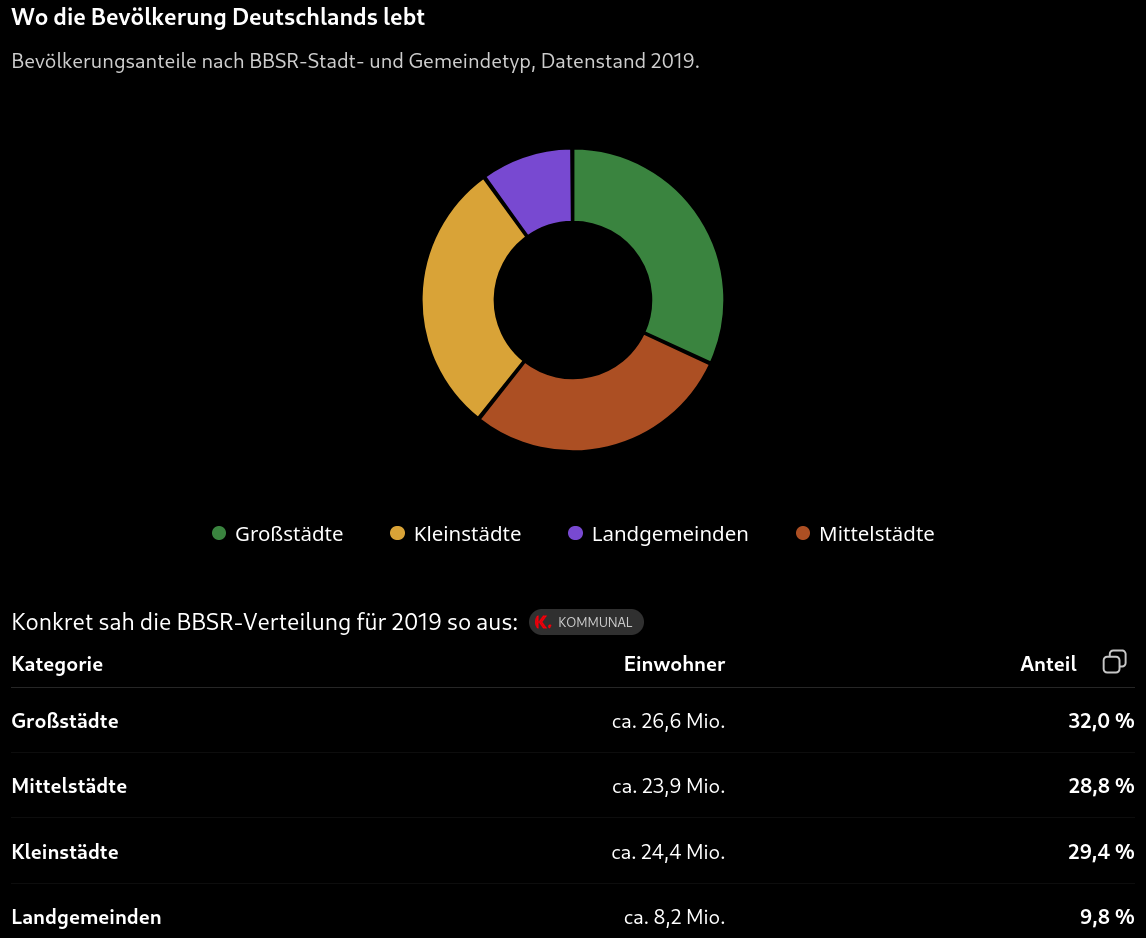
Let me take two real-world examples starting from where I live - they are not invented or constructed. I live on the outskirts of Braunschweig. Statistically, this puts me among the 32% of residents who live in a major city. That means the absolute majority of people live somewhere more rural.
The nearest bus stop is a literal stone's throw from my house. On weekdays (let us not talk about public holidays), two different routes run there, each at 30-minute intervals, so 4 departures per hour in total. (The buses are, incidentally, already dramatically underutilised; I see most buses outside my door carrying 0-10 passengers. At the same time, the vehicles are then stretched thin on later sections of those routes in the city centre - solving that is squaring the circle.)
My situation should therefore be anything but a cherry-picked worst case.
Both examples according to Google Maps, without traffic jams or public transport delays - factor those in and it tilts even further towards private transport.
Client's office
To the office of a client where I currently have to go regularly.
Car: 45 min, public transport: > 2.5 h.
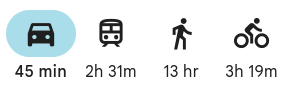
The reason is simply the combinatorics explained above: My neighbourhood is on the outskirts, and apart from those who live here, nobody wants to get here or away from here. It will therefore NEVER make sense to set up a public transport "hub" here; instead, it is connected to Braunschweig's public transport network as a "satellite". The client's office is the mirror-image situation in Hannover: a large complex "in a field" on the outskirts. Only people who have to work in one of the offices there want to go there. Connected by underground towards central Hannover. Anyone who lives in Hannover proper and works there is probably well served by the underground. But that already exists, and we do not need any expansion for that. Anyone who lives on the outskirts of a neighbouring city is lost with public transport, and it cannot be fixed either. Neither does it make sense to develop the origin or destination into a densely interconnected hub, nor is any specific combination of two city outskirts busy enough for a direct connection.
Vet
To the vet.
8 min by car, 50 min by public transport - I could almost walk there in 1 h 5 min.
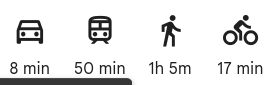
The reason here is simply that it falls below any reasonable level of utilisation. From central Braunschweig, the vet's practice lies in a similar but not the same direction, meaning that on public transport you first have to travel inwards until the routes meet and then travel back out again. Close to the city, you can solve the problem with "orbital buses", but somewhere the rings have to stop as you move outwards. The practice is within Braunschweig's catchment area, but no longer within the city itself. An orbital bus this far out would make no sense whatsoever, economically or ecologically. This problem cannot ultimately be solved either.
I could extend this list by dozens of fails using only real use cases I have, without having to resort to constructed examples. And the really important point is this: My situation is not particularly convoluted. When you look at the statistics, I belong to the big-city third. The cherry-pick is the Green fantasists who live in dense urban areas, work for a government agency in a central location and ask why not everyone commutes by public transport. Especially in Germany, that does not reflect the normal situation.